The Project
Transducers Direct builds pressure transducers in Cincinnati, including the CirrusSense line of battery-powered wireless sensors that report pressure over a long-range radio link. Plenty of the places those sensors would be most useful are hazardous locations: propane storage, fuel handling, and process areas where a flammable atmosphere can be present in normal operation. Selling into those areas means an intrinsically safe product, certified for Zone 1 and Zone 2 service.
The commercial constraint shaped the engineering. A hazardous-location version that shared nothing with the existing product would mean new process fittings, new mounting hardware, a second manufacturing flow, and a sensor that does not drop into the installed base. The new enclosure had to satisfy an intrinsic safety assessment while presenting exactly the same interfaces to the process and to the installer.
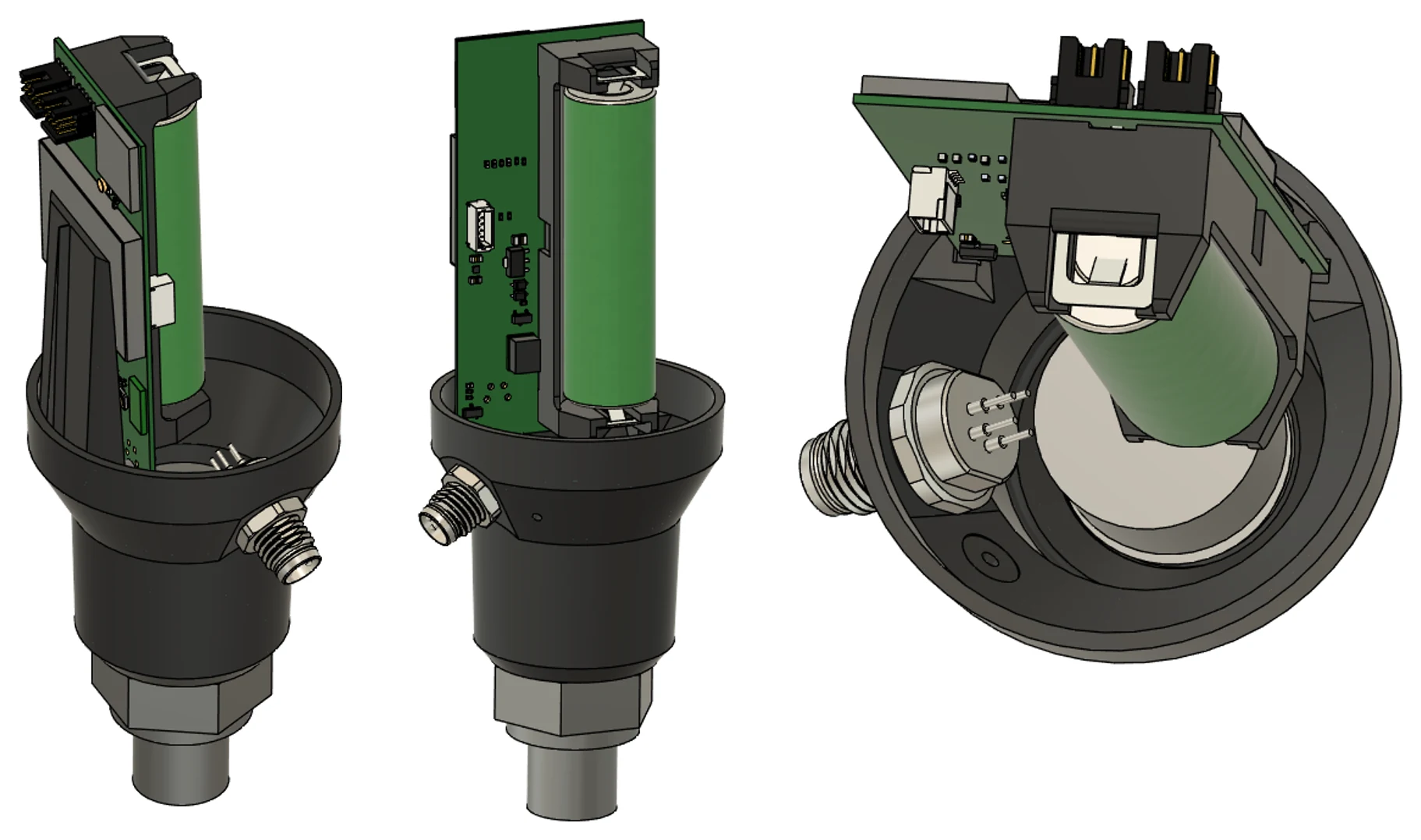
Section views of the intrinsically safe enclosure: board carrier, battery retention, and the carried-over process fitting.
Our Solution
We designed a new intrinsically safe enclosure on the existing transducer form factor. Every interface the outside world touches carries over unchanged: the process fittings, the threads, the seals, and the mounting interfaces are the ones already in the field and already in the factory. What changed is everything the enclosure does internally to satisfy an intrinsic safety assessment.
Transducers Direct laid out the circuit board to the envelope we defined, working against our feedback on the electrical side of intrinsic safety. We handled the mechanical design and the radio modeling.
Mechanical Design
The housing puts a screw-down dome over the board header, with the board carrier and the battery terminals arranged so the cell can be changed in the field without disturbing the process connection or the seal that keeps the enclosure at IP67. Battery access is the feature that decides whether a wireless sensor is serviceable or disposable, and in a sealed hazardous-location housing it is the hardest thing to get right.
The intrinsic safety work is mechanical before it is electrical: clearance and creepage distances between conductors, physical separation between circuits that must not interact under fault, and provisions for encapsulating the parts that need it. Those are enclosure geometry decisions, so they are settled in CAD before the certification review opens. We released STEP and STL models with 2D drawings.
RF Modeling
A sealed housing is a difficult place to put an antenna, and the cost of getting it wrong is a sensor that reports reliably on the bench and intermittently on a tank farm. We modeled the radio link for the long-range network the product uses: link budget and expected range at the 22 dBm output the regional rules allow, the transmit current budget the cell has to supply in the 110 to 130 milliamp range, and the placement and matching of a chip antenna inside the housing we had just designed. Antenna placement is an enclosure decision as much as a circuit decision, and doing both in the same engagement is how the two stay consistent.
Certification Path
The product targets Ex ib IIA and IIC T4 Gb for Zone 1 and Zone 2, certified through CSA Group. We prepared the technical package and took it into a paid review with a CSA certifier ahead of lab submission. That review fixes which standards actually apply, checks the bill of materials to confirm which components carry their own certifications, and flags the risks in the plan and the drawings while they are still cheap to fix. We then reworked the mechanical design against the findings.
Accredited lab certification sits with CSA Group. This engagement prepares the enclosure for that assessment. Approval is granted by the certifier.
Results
Transducers Direct has an intrinsically safe enclosure design that keeps their process fittings, their mounting interfaces, and their installed base, with a field-replaceable battery inside a sealed housing and a radio link that was modeled before the housing was committed. The applicable standards were fixed and the bill of materials checked before the design reached the lab.